
Client Onboarding Is a First-Week Problem: What We Got Wrong for Years
Most client relationships are won or lost in the first week, long before the work is judged. A field note on what quietly breaks the relationship early, and the onboarding we use now.
Founder & Product Lead · Droova
Contents 7 sections
Here is something that took me too long to accept: most client relationships are won or lost in the first week - long before anyone judges the actual work. The kickoff, the first few emails, whether the client can find anything - that first impression sets the tone for the entire engagement. Get it wrong and you spend the next three months managing a slightly anxious client. Get it right and they relax and let you do your job. Here is what I got wrong for years, and the onboarding we use now.
Why the first week matters more than the work
A new client does not yet have any deliverables to judge you on. So they judge you on the only signal they have: how it feels to work with you in week one. Is it organised or chaotic? Do they know what happens next, or are they guessing? When they have a question, is there an obvious place to look, or do they fire off an email and wait? None of that is the work. All of it decides whether they trust you with the work.
What quietly goes wrong in week one
The failures are rarely dramatic. They are small frictions that stack up:
- A messy kickoff. A long call, a flurry of follow-up emails, a shared drive link, an invite to a tool - and the client is now holding five things and sure of none of them.
- 'Where do I send this?' The client has a logo, a login, a document - and no single obvious place to put it. So it lands in your inbox, and something gets lost.
- Invisible progress. You are actually working, but the client cannot see it, so silence reads as inactivity. That is when the 'just checking in' emails start.
- No visible next step. The client does not know what they are waiting for or when. Uncertainty, in week one, feels like risk.
Individually, none of these is a crisis. Together, in the first seven days, they tell a new client 'this is going to be work to manage' - and that impression is expensive to undo.
The onboarding we use now
The fix was not a better kickoff deck. It was giving the client one place, on day one, before the real work even starts:
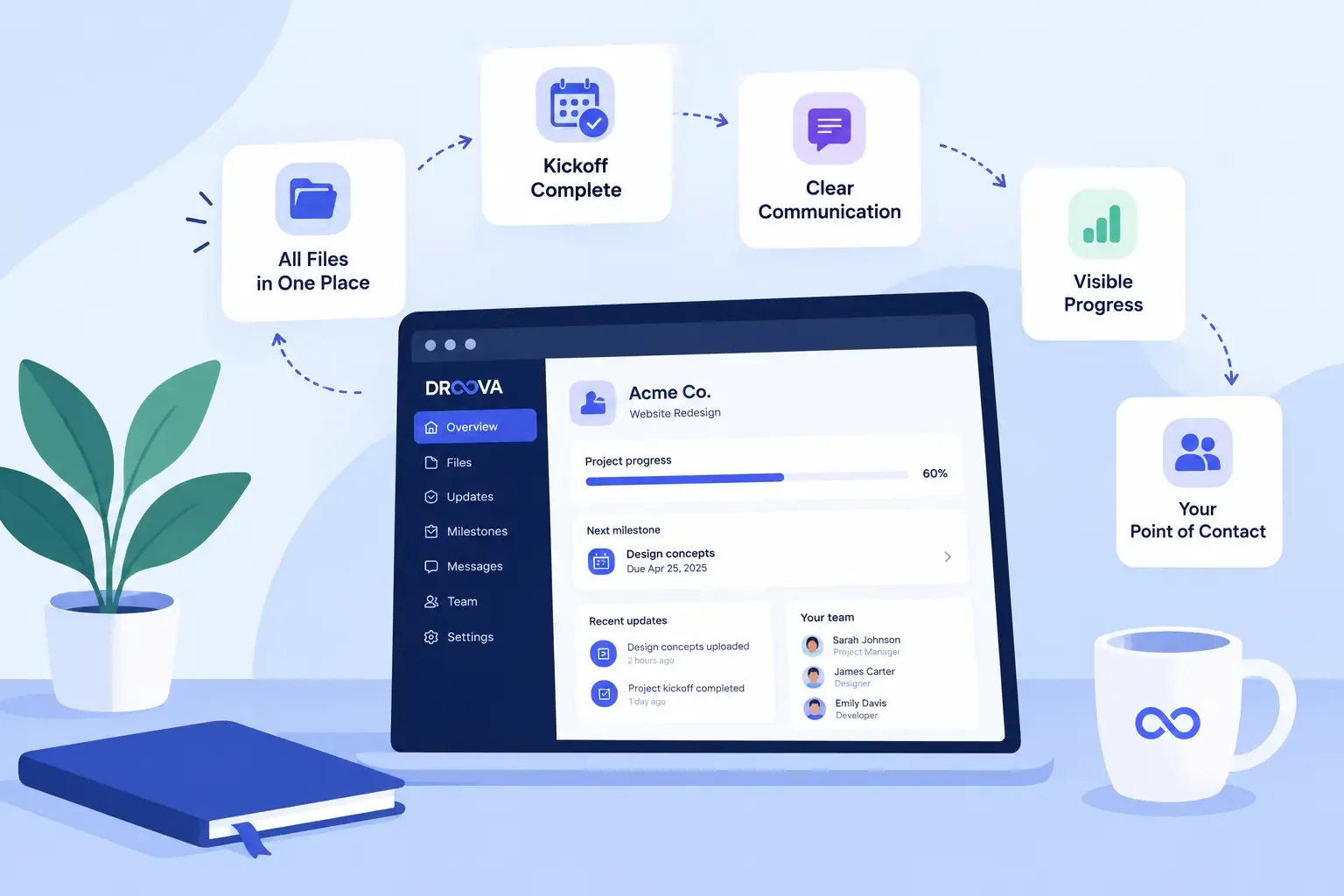
- A branded space on day one. The moment we win the work, the client gets a single client portal link - their name, our brand, everything about their engagement in one spot. No account to create, no tool to learn.
- One home for everything. Files, updates, the next milestone, who to talk to. 'Where do I send this?' has one answer, every time.
- Visible progress from the start. Because the portal reflects the live project, the client can self-serve the 'where are we?' question. That single change removes most of the anxious check-in emails.
- A rhythm and a quick first win. We set the cadence explicitly and aim to give the client one small, visible win in the first few days, so momentum is obvious.
The point of doing this in week one is not the features. It is that the client's very first experience of you is calm and organised - and that feeling carries the whole engagement.
Why a portal on day one changes the first week specifically
A lot of agencies think of a client portal as something for the middle of a project. In my experience its highest-value moment is day one, because it replaces the exact frictions above with a single, branded source of truth before any bad habits form. (It is also why portals that are bolted on later tend to go quiet after a couple of weeks - they were never the client's home to begin with.)
A first-week checklist
Before your next kickoff, make sure the client can answer 'yes' to all of these by day two:
- Do I have one obvious place for everything about this project?
- Do I know exactly what the next step is and roughly when?
- If I have a question, is there somewhere to look before I email?
- Can I see that work is actually happening?
- Do I know who my point of contact is?
The one-sentence version
Clients judge week one on how it feels to work with you, not on deliverables - so the agencies that win give the client a single, branded home on day one, make progress visible, and remove the 'where do I send this?' friction before it ever starts.
If your onboarding still lives across email, drives and a kickoff call, see what consolidating it costs and saves with our free stack audit, or book a demo and I will show you a real client's first week inside Droova.
Frequently Asked Questions
Why is the first week of a client engagement so important?
Because a new client has no deliverables to judge yet, so they judge how it feels to work with you: organised or chaotic, clear or uncertain. That first impression sets the tone and trust level for the entire engagement, long before the work itself is assessed.
What is the most common client onboarding mistake?
Scattering onboarding across a kickoff call, follow-up emails, a shared drive and a tool invite, so the client has no single place to go. It creates 'where do I send this?' confusion and makes your progress invisible, which triggers anxious check-in emails.
How does a client portal help with onboarding?
Giving the client a branded portal on day one replaces the scattered emails and drives with a single source of truth: files, updates, the next step and their point of contact in one place, with no account to create. It makes the first week feel calm and organised.
When should you give a client access to a portal?
On day one, before the real work starts. Portals added mid-project tend to go unused because they were never the client's home. Introducing it at the very start makes it the natural place the client checks, which is when it actually reduces email and builds trust.
More from the journal
Tactics for running service businesses better - without the fluff.
Browse all posts →