
The 7-Tool Agency Tax: Why Your Stack Is Quietly Breaking (And How to Fix It)
Most agencies didn't choose fragmentation. They added one tool at a time, each solving a real problem. The math only fails when you add it up and the fix isn't a better tool. It's fewer tools.
Founder & Product Lead · Droova
Contents 7 sections
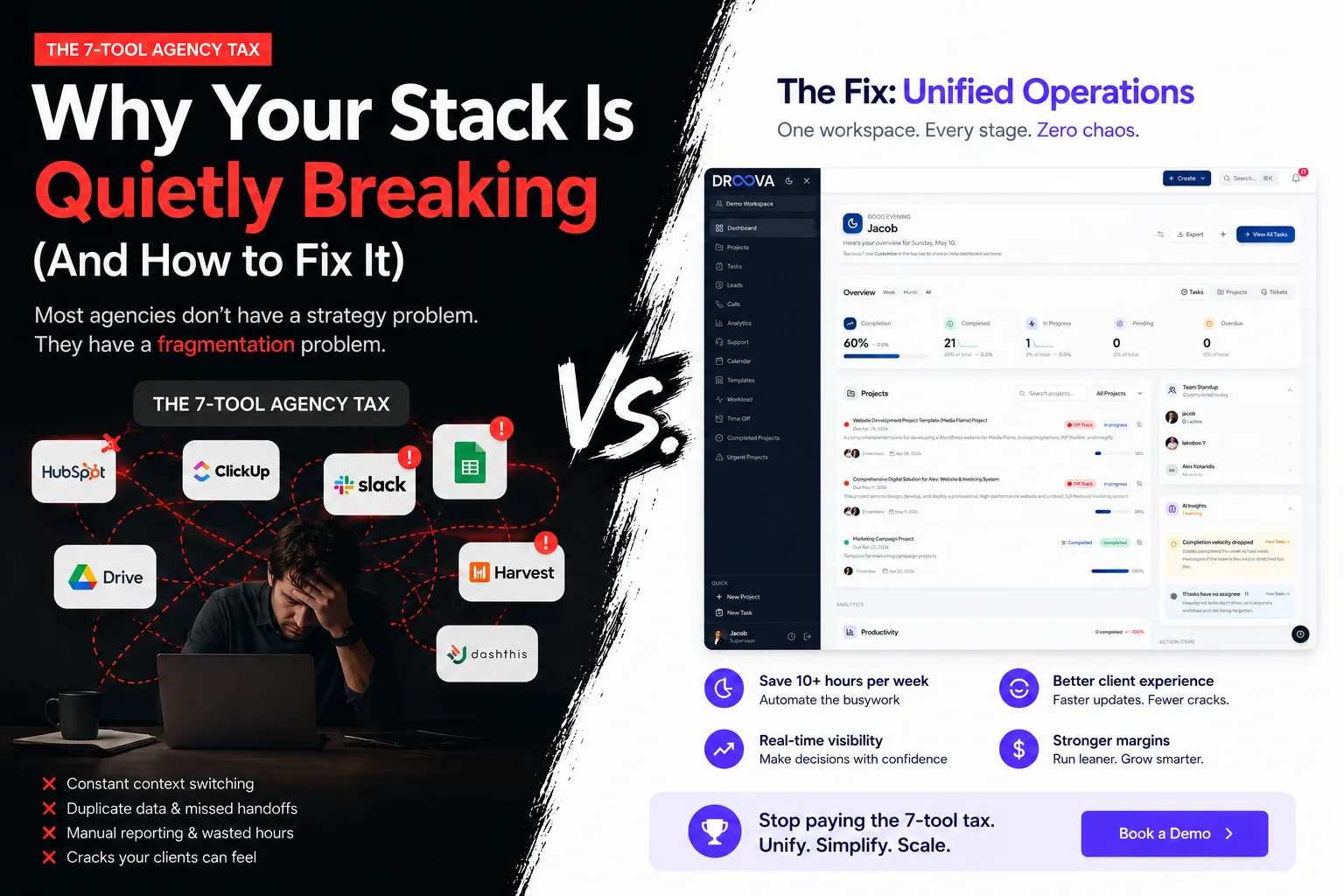
Most agencies don't choose fragmentation. It happens to them. One tool at a time, each solving a real problem the founder couldn't ignore, until one day the agency wakes up running its operations across seven different SaaS subscriptions, four browser tabs, and a Zapier dashboard that nobody understands anymore.
The problem isn't any single tool. It's the operational gaps between them.
This is the article most founders need to read about three years into running an agency exactly when the stack stops working but they can't quite articulate why.
Why agencies start adding tools in the first place
Stack sprawl starts innocently. Year one, the founder is running everything out of Trello and a Google Sheet. Year two, you hire your first AM and you need to track client work properly so you adopt Asana. Year three, leads start coming in faster than you can track in your inbox, so you adopt HubSpot. Year four, a client asks why they don't have visibility into the work, so you add Copilot. Year five, the partners want monthly reports without your AMs spending 6 hours building them, so you add DashThis.
Each tool, taken individually, was the right decision. Each one solved a real problem at the moment of adoption. That's why fragmentation feels invisible. The cost is never in a single tool it's in what happens between them.
The hidden costs of a fragmented workflow
Once your agency runs on 5+ tools, here's what starts happening invisibly:
1. Onboarding becomes brutal
A new hire has to learn 7 separate systems before they can run a project. Each tool has its own login, vocabulary, and permission model. The "where do I look for X?" Slack messages multiply for the first 90 days.
2. Context switching kills depth
Cal Newport-style "deep work" becomes impossible when an AM has to bounce between Slack, HubSpot, ClickUp, Drive, and Notion just to write one weekly client update. Research suggests recovery time after a context switch is 20-25 minutes; multiply that across a day and an AM loses 1.5-2 hours of cognitive depth.
3. Duplicate data creeps in
Client info exists in HubSpot. Project info exists in ClickUp. File version exists in Drive. Communication history exists in Slack. The same client appears five times in five different shapes, with five different "latest" sources of truth. When they don't match (and they often don't), nobody knows which is canonical.
4. Handoffs slip through gaps
A deal closes in HubSpot. Does anyone create the project in ClickUp? Sometimes. Does the time tracker know about this engagement? Maybe. Does the client portal get spun up? Often not. Each handoff between tools is a place where work goes missing and missing work is what kills retainer renewals.
5. Reporting becomes a part-time job
Because the data lives across five tools, monthly reporting becomes a manual assembly process. Pull from HubSpot, pull from ClickUp, pull from Harvest, pull from your ads platform, paste into a deck. One AM somewhere is losing 4-6 hours a month to this and the report is stale the moment they hit send.
6. Clients feel the cracks
The client doesn't see your stack. They see the symptoms: status emails that arrive late, conflicting answers from different team members, files in inconsistent formats, "we'll get back to you" pauses while your team checks four different systems. They don't know it's a tool problem. They just feel a small, accumulating layer of friction and at renewal time, friction is what tips them toward your competitor.
The "integration tax" - the invisible line item nobody adds up
The reflex response to fragmentation is integration. "Just connect them all." Zapier, Make, native integrations. Surface-level, this works. Beneath the surface, it adds a new tax:
Zapier subscriptions: $20-99/month per agency, often duplicated
Sync fragility: a Zap breaks silently, you find out two weeks later when a client mentions a missing task
Two-way conflicts: when two tools both think they're authoritative, you get phantom records and duplicate notifications
Maintenance overhead: 1-2 people on your team become the "Zap whisperers" who fix things when they break
This is the integration tax. It's real and it's significant and crucially, it's worse than the fragmentation it's trying to solve, because now your operations depend on a brittle layer of glue most of your team can't see and can't fix.
Why project management alone stops being enough
Most agencies hit a ceiling around 10-15 people where their PM tool (ClickUp, Asana, Monday) stops being sufficient. Not because the tool got worse but because the problems the agency has stopped being primarily project management problems.
At 15 people, the bottleneck shifts from "can we deliver the work?" to "can we run the business that delivers the work?" That means CRM, client portal, reporting, time-to-margin, renewal forecasting categories that PM tools don't address. So you bolt on three more tools and find yourself back at square one of the fragmentation problem.
What "unified operations" actually looks like
The alternative is a different mental model. Instead of "what tool do I use for X?", you think "what's the next stage of the engagement?" Lead → project → portal → support → renewal - one workspace, one source of truth, one branded surface for the client.
This is the Agency OS idea. Pipeline, projects, client portal, and reporting living natively in the same database so the handoffs between them are instant and lossless. No Zaps. No manual data assembly. No "did the project get created?" panic when a deal closes.
It's also the reason this is hard to retrofit onto a PM tool with bolt-on integrations. Either everything is one product, or you're paying the integration tax.
How to know if it's time to consolidate
You're probably ready to consolidate if any 3 of these are true:
You run 5+ paid SaaS tools to deliver client work
You have a Zapier or Make plan keeping them in sync
At least one Zap broke in the last 30 days
Your AMs spend 2+ hours per week on weekly status emails
Your monthly report process is 4+ hours of manual assembly
A client asked for visibility into work in the last 90 days
You've onboarded a new hire and they took >2 weeks to be productive on the stack
If you check 3+, you're paying the 7-tool tax. The longer you wait, the more it costs you both in dollars and in renewals you don't notice you're losing.
What's next
If this resonates, run the free 2-minute Stack Audit it gives you your annualized cost in concrete dollars based on the tools you currently run. Or if you'd rather talk it through with a human, book a 30-min demo and we'll map your stack to Droova's Agency OS in real time.
The fix isn't a better tool. It's fewer tools.
More from the journal
Tactics for running service businesses better - without the fluff.
Browse all posts →