
Client Portal vs Slack vs Email: How Agencies Should Actually Communicate With Clients in 2026
Email, Slack, WhatsApp and client portals all break in predictable ways. From 50+ agency conversations and our own pilots, here is when each actually works - and why the login is what kills most portals.
Founder & Product Lead · Droova
Contents 12 sections
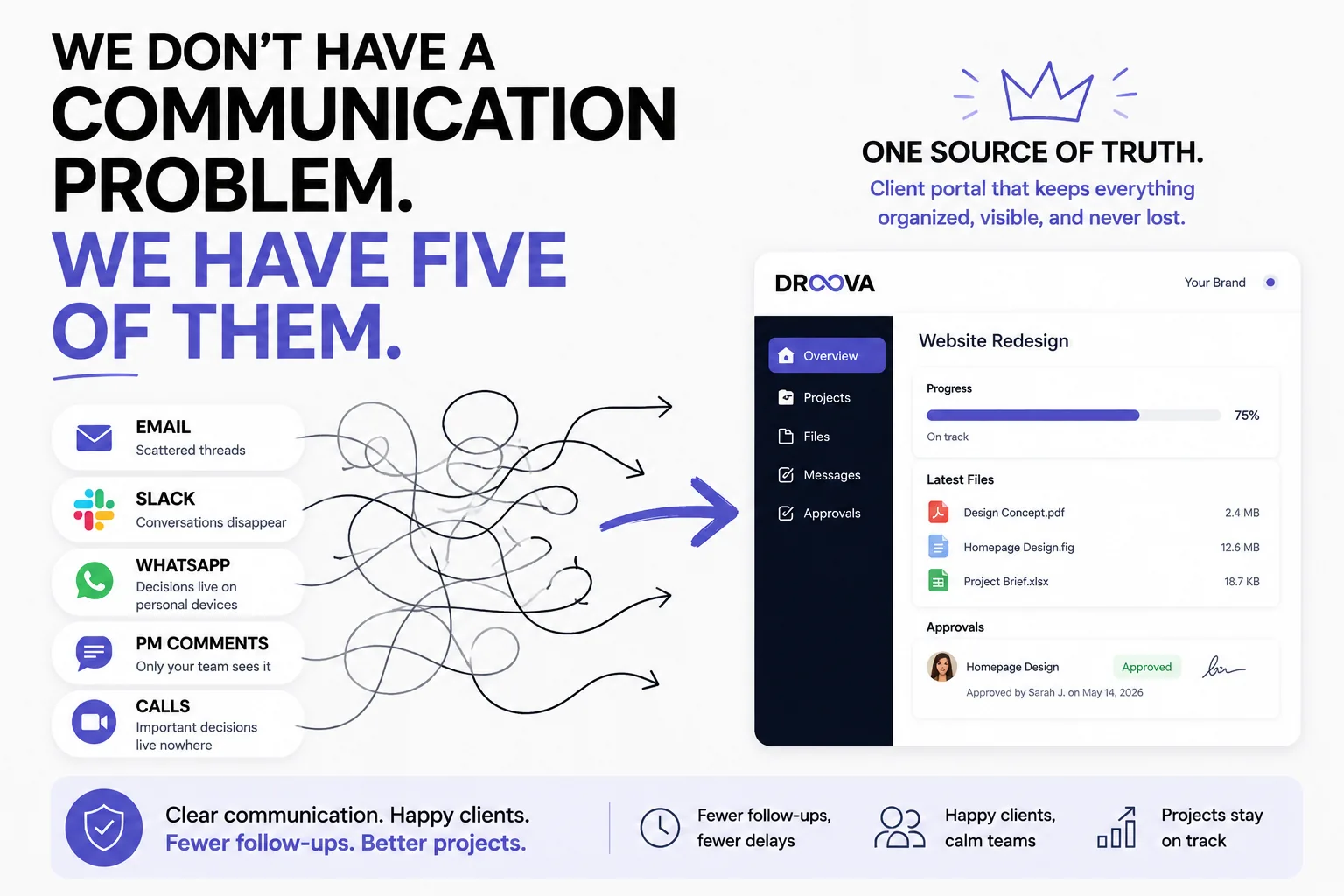
Every few weeks an agency owner tells us some version of the same thing: "We don't have a communication problem with clients. We have five of them." They email. They Slack. They leave comments in the project tool. Some clients text on WhatsApp. And somehow, the client still asks the question that was already answered last Tuesday.
So the real question is not "email or Slack or a client portal?" It is "why does client communication keep fragmenting no matter which tool we pick?" After dozens of conversations with agency founders, a stack of tech-stack audits, and running Droova pilots on real client work, here is what actually holds up - and where each option quietly breaks. This is not a feature checklist. It is what we keep seeing happen on live projects.
How agencies actually communicate today
Almost nobody picks one channel. A single project usually runs across four or five at once:
- Email for anything "official" - approvals, scope changes, invoices.
- Slack or WhatsApp for speed and informal back-and-forth.
- Comments inside the PM tool for task-level detail.
- A shared drive link for files, usually pasted into one of the channels above.
- The occasional video call where the most important decisions get made - and then live nowhere.
Each channel is fine on its own. The damage comes from the seams between them: the decision made on a call that never made it into the project record, the file emailed to one person who was on leave that week, the "approved, go ahead" buried in a Slack thread that scrolled away. The tool is rarely the problem. The gaps between tools are.
One agency owner described a single deliverable to us this way: the design approval lived in Slack, the final file lived in Google Drive, and the client's written feedback arrived by email. Three weeks later, when the client questioned the invoice, the team spent half a day reconstructing who approved what, and when, across three tools - before they could even send a reply. Nothing was technically lost. It was just scattered across enough places that "what did we agree?" became an afternoon of detective work.
Email: the lowest-friction option that scatters the truth
Where it works: Everyone has it. No login, no onboarding, no friction. It is the natural home for formal sign-offs and anything you may need as a paper trail later - scope, contracts, invoices.
Where it breaks: Information scatters across inboxes and threads. The approval lives in one person's email; the brief in another; the latest file in a third. There is no single place that represents "the current state of this project." When someone new joins - or the account manager goes on holiday - the context is effectively gone, because it was never anywhere central to begin with.
The hidden cost: Nobody can answer "what was the last thing we agreed?" without forwarding a chain and hoping it is complete. We have watched agencies lose half a day reconstructing a decision that took thirty seconds to make - because the record of it was scattered across six messages and two people.
Slack and chat: fast, until they set the wrong expectation
Where it works: Genuinely the best channel for quick, low-stakes back-and-forth. It feels collaborative and modern, clients enjoy it, and it keeps small things from turning into formal email ping-pong.
Where it breaks: Two ways, consistently.
First, chat trains clients to expect near-instant replies. A shared channel quietly becomes a support obligation you never agreed to and never priced. We have seen account managers feel unable to step away from their desk because "the client is in Slack and expects an answer." That is scope creep disguised as good service.
Second, decisions made in chat evaporate. A message scrolls away, and the "yes, go ahead" that authorised a week of work is unsearchable a month later. When the invoice is questioned, there is no clean record of who approved what.
Chat is a conversation, not a system of record - and the moment you treat it as one, you are exposed.
WhatsApp and text: convenient, and a compliance grey zone
For a lot of agencies, the client's preferred channel is WhatsApp. It is frictionless and personal, which is exactly why it is dangerous: project decisions end up on a personal device, tied to one person, invisible to the rest of the team, and impossible to hand over if that person leaves. It is the most extreme version of the "decision lives nowhere" problem.
PM tool comments: precise, but only the team is really there
Task-level comments inside your project tool are great for internal precision. The trouble is the client rarely lives there. Either they are asked to create yet another login (and don't), or they are given limited "guest" access that feels clunky, so they default back to email anyway. The detail is captured - but the person it is meant for never sees it.
Client portal: clients hate logging in - unless you remove the login
Where it works: A portal is the only option that keeps status, files, approvals and updates in one place that both sides can see. Nothing scatters, because there is one source of truth. When it is done well, the client stops chasing you for updates because they can simply look.
Where it breaks: The classic failure is friction. The moment a portal demands the client create an account, remember a password, and "log in to check progress," adoption collapses. Clients will not maintain yet another login for your agency - they have ten already. This single design choice is why so many agencies tried a portal once, watched clients ignore it, and quietly went back to email.
The portals that actually get used remove that friction entirely: a link the client can open with no account, that always shows the current state. The tool stops being "another place to check" and becomes the place.
What clients actually want
It is easy to assume clients want more communication. In our conversations, they mostly want the opposite: they want to not have to chase you. They want to know, at any moment and without effort, where things stand - is it on track, what is waiting on them, what was delivered. They do not want a new login, a new app, or to be "in your system." They want certainty with zero overhead. Whatever channel delivers that wins; whatever adds a step loses.
The channels, side by side
The same trade-offs, in one view:
| Channel | Speed | Record keeping | Client adoption | Long-term reliability |
|---|---|---|---|---|
| Medium | Poor | High | Medium | |
| Slack / chat | High | Poor | High | Low |
| WhatsApp / text | Very high | Very poor | Very high | Very low |
| PM tool comments | Medium | Good | Low | Medium |
| Client portal | Medium | Excellent | Medium-high | Excellent |
The pattern is hard to miss: the fastest, most-adopted channels are the worst at keeping a record, and the only channel that is excellent at record-keeping is the one that has to earn its adoption by removing friction.
What we kept seeing
The pattern across the agencies we talked to was not "one channel is best." It was this:
- Email is unavoidable for formal trails, but it is where context goes to die.
- Chat is great for tempo and terrible as a system of record.
- WhatsApp is the most convenient and the most fragile.
- A portal solves the scatter problem - but only if it removes the login friction that killed the last one they tried.
The agencies that felt calmest about client comms were not the ones with the cleverest tool. They were the ones who had drawn a clear, deliberate line: chat for the conversation, a portal for the record. The portal held the things that must not get lost - progress, deliverables, approvals, files - and chat handled the human, in-the-moment stuff. The boundary was the whole point.
The verdict: when each one actually works
- Use email for contracts, invoices, and formal sign-offs you may need to reference legally.
- Use chat for quick questions and relationship-building - but set hours, and never let an approval live only in a chat thread.
- Avoid WhatsApp for anything that matters to the project; if a client insists, mirror every decision into the project record the same day.
- Use a client portal as the single place the client checks "where are we?" - status, files, and deliverable approvals that survive staff changes and holidays.
How to draw the line in practice
You do not need to ban channels. You need one rule: anything that changes the project - a decision, an approval, a deliverable, a scope change - has to land in the record, no matter where the conversation happened. The conversation can live in Slack or on a call. The consequence of the conversation lives in one place everyone can see. Most of the chaos we see disappears the moment an agency adopts that single habit.
How we approached it in Droova
This comparison is exactly why our client portal is built around removing the login. Each project generates a shareable link - optionally password protected - so clients see progress, files, and updates without creating an account. Approvals and feedback are captured against the project record (with the client's name and email as a sign-off), so the "yes, go ahead" never disappears into a chat thread. Inside the same workspace, your team works the project with full task-level detail; the client sees only the clean, branded surface you choose to share. The conversation can still happen wherever your client likes - the record stays in one place.
If you want to see how that plays out on a real project - including how a deliverable approval gets recorded so it survives a staff change - book a 30-minute demo and we will walk through it with your own workflow.
For the fundamentals, see what a client portal is.
More from the journal
Tactics for running service businesses better - without the fluff.
Browse all posts →