
Why Agencies Outgrow ClickUp, Asana, and Notion (And What They Switch To)
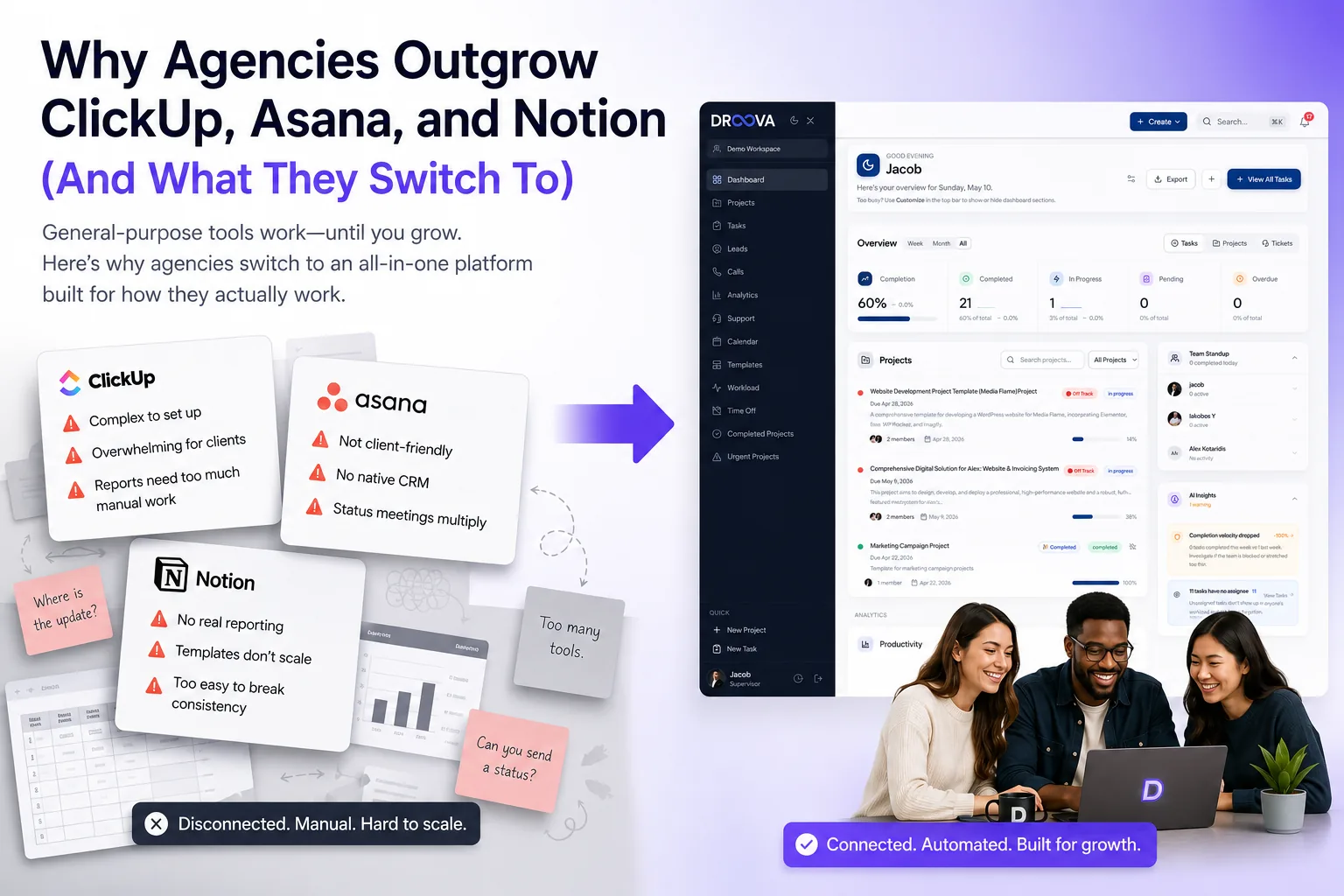
Every agency starts with general-purpose tools. At some point usually around 5-15 employees they break. Here's exactly why ClickUp, Asana, and Notion stop working for growing agencies, and what to switch to.
Contents 9 sections
Every agency goes through the same evolution. You start lean. You sign up for ClickUp because a friend recommended it. Or Asana because it's the safe choice. Or Notion because it's beautiful and infinitely flexible. For the first year, the tool feels like magic. You set up boards, customize workflows, build templates, and feel productive.
Then somewhere between five and fifteen people, the magic breaks. Tasks duplicate across boards. Clients start emailing for updates because they can't see what's happening. Salespeople work in spreadsheets because the CRM workaround you built feels clunky. Status meetings creep back in. Templates stop being reused because no one remembers where they live.
This isn't a tool problem. ClickUp, Asana, and Notion are excellent at what they were designed for. The problem is that agencies stop being what those tools were designed for. Here's what actually happens, why it happens, and what agencies switch to when they outgrow general-purpose tools.
The Honeymoon Phase: Why It Works at First
In the early days, an agency is small enough that any tool works. Three people in a Slack channel coordinating with shared spreadsheets can ship great work. The tooling is almost invisible because the team is small enough to communicate verbally.
When you adopt ClickUp, Asana, or Notion at this stage, the tool feels transformative. Suddenly you have boards, deadlines, assignees, and dashboards. You feel professional. You demo it to clients and they're impressed. The first six months are euphoric.
What's actually happening: the tool is solving a coordination problem that was already small. It feels powerful because the gap between "no system" and "any system" is huge. The real test comes later, when the gap between "any system" and "the right system" becomes the bottleneck.
The Breaking Points (Where General-Purpose Tools Fail)
Here are the specific scenarios where ClickUp, Asana, and Notion start to break for agencies. If you're nodding through more than two of these, you're at the inflection point.
1. Clients Have No Visibility (and Won't Stop Emailing)
None of these tools are designed as client-facing. ClickUp has guest access, but clients see ClickUp's UI and have to learn ClickUp to find anything. Asana has similar guest features with the same friction. Notion has page sharing, but you're either showing them too much (internal comments leak) or too little (a stripped-down page that loses context).
What actually happens in practice: agencies stop inviting clients to the tool entirely. Instead, the project manager spends two hours every Friday writing status emails. Clients still email mid-week asking "Where are we on this?" because the email summaries are stale by Monday.
This is the most common breaking point. It's also the one that hurts retention most - because clients who don't feel informed start questioning value.
2. CRM Becomes a Spreadsheet (or HubSpot Becomes Required)
None of these tools have native CRM. You can build one in ClickUp using custom fields and lists. You can fake one in Notion with a database. Asana doesn't really pretend to do it. Either way, the team eventually splits: sales lives in a spreadsheet (or HubSpot), delivery lives in the PM tool.
The fracture creates a familiar pain: when a deal closes, someone manually creates the project. Context evaporates. The client says "I already told your team this" during the kickoff call. Trust takes a hit. Repeat for every project.
Adding HubSpot solves the CRM problem and creates a new one: you now have two tools, two costs, two onboarding sessions for new hires, and zero shared data layer between sales and delivery.
3. Status Meetings Multiply
Every agency has the same arc with status meetings. Year one: no meetings, just Slack. Year two: weekly project standup. Year three: standup, client check-in, internal review, and a leadership sync. By year four, half the team's calendar is "syncs about syncs."
Why do they multiply? Because the tooling stops giving managers enough visibility. Asana's dashboards are decent but require manual upkeep. ClickUp's reports need configuration. Notion has no real reporting at all. So managers schedule meetings to get the information the tool isn't surfacing.
Status meetings are the most reliable indicator that your PM tool is failing at its actual job: making the work visible.
4. Templates Stop Being Reused
Early on, you build a beautiful project template. Discovery phase. Design phase. Development phase. Launch checklist. It works for the first three projects. Then the team starts skipping it because it doesn't quite fit, modifying it for one project type, abandoning it for another. Six months later, no one remembers where the canonical template lives.
This isn't a discipline problem. It's a tooling problem. Notion templates rot because pages are easy to copy and modify. ClickUp templates have configuration that doesn't survive across workspaces. Asana templates are decent but get diluted as new project types emerge.
What actually solves it: templates that include not just tasks but also CRM stages, client communication patterns, and deliverables. General-purpose tools rarely capture all three.
5. The Tool Stack Hits 6-8 Subscriptions
By year three, most agencies are running:
PM tool (ClickUp/Asana/Notion)
CRM (HubSpot/Pipedrive)
Communication (Slack)
File storage (Google Drive/Dropbox)
Time tracking (Toggl/Harvest)
Invoicing (Stripe/QuickBooks)
Forms/intake (Typeform)
Maybe: dedicated client portal (Copilot/SuiteDash)
Each tool costs $10-50/seat. Combined: $80-200/seat/month. For a 15-person agency, that's $14k-36k/year on tooling - before considering the time cost of integrations, training, and context-switching.
The cost itself isn't the problem. The problem is that none of these tools share a data model. A client lives in your CRM, a project lives in your PM tool, a file lives in Drive, a contract lives in DocuSign, an invoice lives in Stripe. Connecting them through Zapier works until it breaks silently - and you find out three weeks later when a client asks why their invoice was never sent.
6. Onboarding New Hires Takes Two Weeks
The hidden cost of a fragmented stack: every new hire needs to learn 6-8 tools, find their accounts, get permissions configured, and figure out which tool is the source of truth for what. Two weeks before they're productive, sometimes longer.
When the stack is unified, onboarding compresses to days because new hires only learn one navigation pattern. They see CRM, projects, time tracking, and client communication in the same UI. Context-switching disappears.
7. Reporting Becomes Impossible
Try answering this question with your current stack: "What's our average margin by client type, and which lead sources produce the highest-margin clients?"
To answer it, you need lead source from the CRM, project costs from the PM tool plus time tracking, and revenue from invoicing. You'd export each, match records by client name (which is messy because spelling varies), build a pivot, and pray.
Most agencies try this once, give up, and operate on instinct. They miss patterns that would change their pricing, their lead-gen focus, and their hiring decisions. The cost of not knowing is invisible but enormous.
Why It Breaks at This Stage Specifically
The 5-15 person range is where general-purpose tools stop scaling. Below five people, communication is verbal and tools are ornamental. Above fifteen, you've usually either solved this (with the right tools) or built a bureaucracy that can survive bad tooling. The middle is where the gap is widest and most painful.
Three things change at this stage:
Client count grows past memory. When you had five clients, you remembered everything. With twenty, you can't. Tooling has to carry the load you used to carry in your head.
Roles specialize. Sales and delivery become different people. Information has to flow between them through a system, not through conversation.
Profitability matters. When you're scrappy and growing, "are we busy?" is the only metric. When you're scaling, "are we profitable on each engagement?" is the only metric. Answering it requires connected data.
The Three Paths Agencies Take
When agencies hit this wall, they take one of three paths.
Path 1: Stay and Bolt On (Most Common, Worst Outcome)
The default move is to keep ClickUp/Asana/Notion and add tools to fill gaps. Need a CRM? Add HubSpot. Need a portal? Add Copilot. Need better reporting? Add a BI tool. Need integrations? Add Zapier or Make.
This works for a while, but each addition creates new fragility. Integrations break. Data falls out of sync. New hires struggle. The tool count keeps climbing, and the original PM tool becomes one node in a tangled graph rather than the source of truth.
Most agencies eventually leave this path because the maintenance cost of the integration layer exceeds the cost of just switching to a unified platform.
Path 2: Fragment Further (Worst Outcome, Sometimes Necessary)
Some agencies double down on specialization: a "best in class" tool for each function, accepting that integrations will be loose. This works for very large agencies (50+ people) with dedicated ops teams who can maintain the stack. It rarely works for the 5-50 range - there's not enough operational capacity to keep the stack healthy.
If you're in this range and considering this path, you're usually doing it because no unified platform fits your specific workflow. That's a real reason. Just budget for the ops cost.
Path 3: Unify on a Platform (Best Outcome for Most)
The third path is to consolidate onto a platform built specifically for the agency lifecycle: CRM + projects + portal + communication, all sharing one data model. Migration is painful for a few weeks, then daily life gets dramatically simpler.
The trade-off: you give up some best-in-class depth in exchange for integration. ClickUp's PM features are deeper than most unified platforms. HubSpot's marketing automation is richer than most unified platforms. But the cost of "best in class everywhere" is the integration tax we just described.
For most agencies, the right level of depth in each function combined with native integration beats best-in-class with bolted integrations. Unified platforms are how teams stop spending Mondays in syncs about other syncs.
What Unified Looks Like
A unified agency platform handles, in one product:
Lead pipeline with sources, stages, and conversion analytics
Lead-to-project conversion that preserves all context
Project management with kanban, list, calendar, and Gantt views
Client portal that's branded and doesn't require account creation
Time tracking linked to tasks and projects
Support tickets linked to projects so post-launch issues stay tracked
Reporting across the entire client lifecycle
The benefit isn't that any single feature is best-in-class. It's that the data model connects them. When a lead converts to a project, all the sales context flows over. When a client logs in, they see exactly the right information branded as your agency. When a project completes, the support tickets continue in the same system without re-entering data.
That continuity is what general-purpose PM tools can't deliver - not because they're bad, but because they're built for a different shape of work.
Migration: How to Switch Without Losing Momentum
Switching tools at this stage is intimidating. Here's the playbook agencies use to minimize disruption.
Don't Big-Bang the Migration
Don't try to move every active project on day one. Start new projects in the new system. Let existing projects finish in the old one. After 60-90 days, you'll have moved organically.
Migrate the Pipeline First
Sales pipeline is the easiest migration target - fewer records, more structured data. Move the CRM in week one, get the sales team comfortable, then layer in projects.
Onboard One Client First
Pilot the client portal with one friendly account. Watch their behavior. Listen to their feedback. Iterate on the welcome flow before rolling out broadly.
Cancel the Old Tool After 90 Days
Don't keep paying for both for six months out of comfort. Set a hard date. The forcing function is what completes the migration.
The Decision Framework
If you're trying to figure out whether you've actually outgrown your current tool, here's a practical test:
Count the tools your team uses to deliver client work. If it's more than 5, you have an integration problem masquerading as a PM problem.
Ask three project managers: "Where would I find the budget for the Acme project?" If they give different answers, your data isn't unified.
Calculate hours spent in status meetings per week, agency-wide. If it's more than 5% of total hours, your tool isn't surfacing enough information automatically.
Look at your last three onboardings. Did new hires take more than a week to find their bearings? You have a stack-complexity problem.
Two or more "yes" answers is the threshold. Time to switch.
What Agencies Switch To (Specifically)
The most common destinations from ClickUp, Asana, and Notion in 2026 are:
Droova - built for agencies; CRM, PM, portal, and client comms in one
HubSpot + ClickUp - keeps you on familiar tools, adds CRM but deepens the integration tax
Monday Work + Monday CRM - two products that talk; better integration than separate vendors but two subscriptions
Teamwork - agency-focused PM but no CRM; you'll still need a sales tool
The right pick depends on whether you want to consolidate or specialize further. Most growing agencies pick consolidation because the operational tax of specialization is the thing that hurt them in the first place.
The Bottom Line
Outgrowing ClickUp, Asana, or Notion isn't a sign that those tools are bad. They built generally excellent products for general work. Agencies are specific work client-facing, multi-stage, lead-driven, branded. The mismatch eventually shows up no matter how skilled your team is at customizing general-purpose tools.
If two or more of the breaking points in this article describe your agency's current week, you're not lazy or disorganized. You've outgrown the tool. Switching to something built for your shape of work is the highest-leverage decision you can make at this stage.
Curious if Droova fits? Book a 30-minute demo, or explore the ClickUp alternative, Asana alternative, and Notion alternative comparison pages for a side-by-side look.
More from the journal
Tactics for running service businesses better - without the fluff.
Browse all posts →